

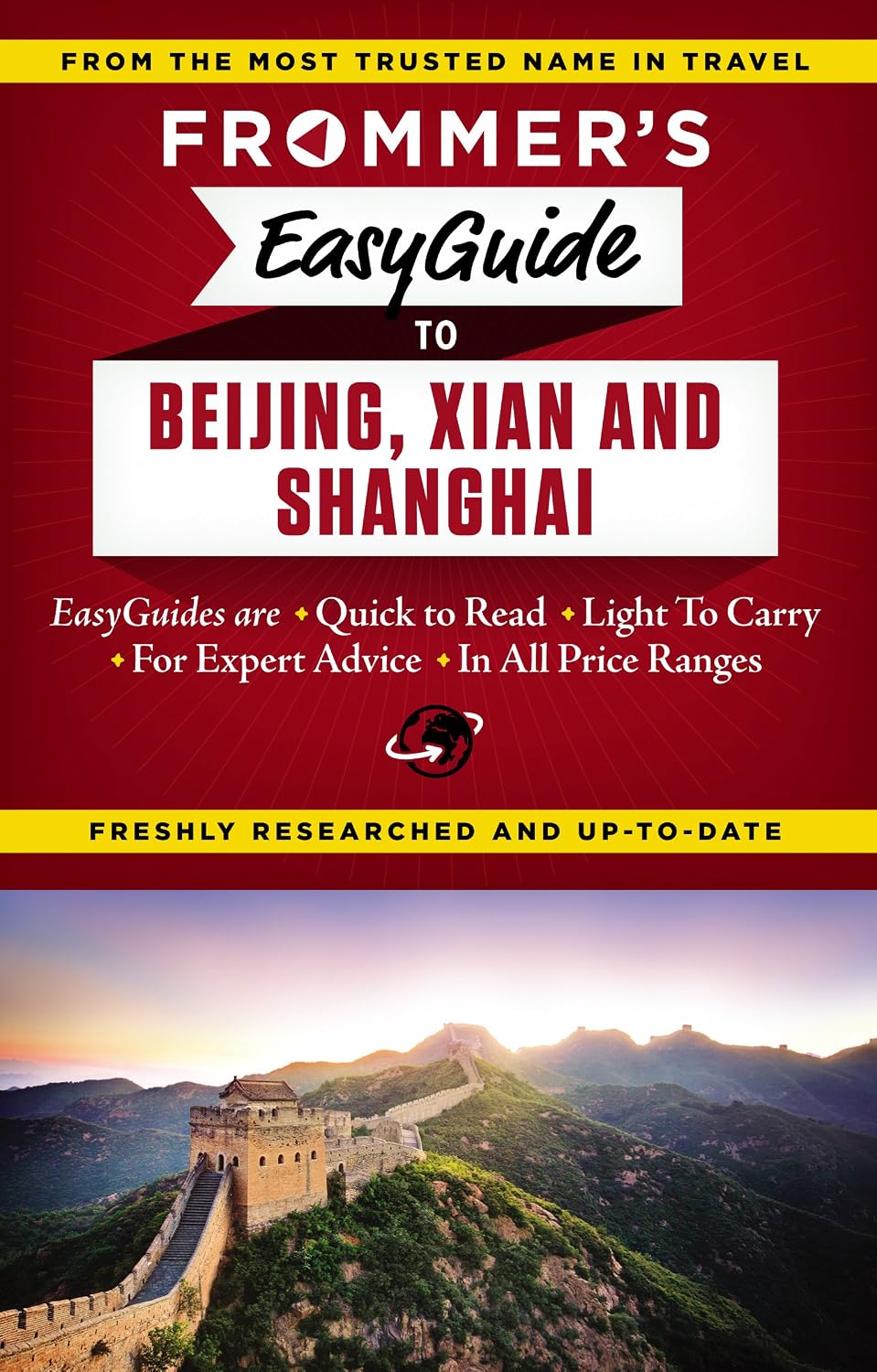
Travel Guide to China 2026: Top 10 places anywhere (Travel guide to the world 2026)
Product details
| Management number | 233711236 | Release Date | 2026/06/27 | List Price | $90.00 | Model Number | 233711236 | ||
|---|---|---|---|---|---|---|---|---|---|
| Category | |||||||||
China is what happens when 5,000 years of history decides it’s not done yet and also wants to dominate the future. It’s a place where emperors once ruled from the vast courtyards of the Forbidden City, and now algorithms hum quietly in glass towers in Shenzhen.It can serve you hand-pulled noodles perfected over centuries in a quiet alley, then deliver bubble tea to your doorstep in ten minutes using an app you’ve never heard of. One moment you’re walking along the ancient Great Wall of China, wondering how it was built; the next, you’re speeding past landscapes at 300 km/h on a bullet train, wondering how that was built.China is organized as a unitary state with several different types of administrative divisions. At the top level, the country is divided into these main categories:1. Provincial-Level Divisions (First Level)China officially has 34 provincial-level administrative units. These are the highest-level divisions under the central government.Anhui, Fujian, Gansu, Guangdong, Guizhou, Hainan, Hebei, Heilongjiang, Henan, Hubei, Hunan, Jiangsu, Jiangxi, Jilin, Liaoning, Qinghai, Shaanxi, Shandong, Shanxi, Sichuan, Yunnan, Zhejiang, Taiwan, Beijing, Shanghai, Tianjin, Chongqing, Guangxi, Inner Mongolia, Ningxia, Xinjiang, Tibet, Hong Kong, MacauA. Provinces (23)These are the standard administrative units, similar to “states” in other countries. The 23 provinces are:Each province has its own local government but is ultimately controlled by the central government.B. Autonomous Regions (5)These are large areas with significant ethnic minority populations. They are theoretically granted more legislative and cultural autonomy. The 5 autonomous regions are:Guangxi Zhuang Autonomous RegionInner Mongolia Autonomous RegionNingxia Hui Autonomous RegionXinjiang Uyghur Autonomous RegionTibet Autonomous RegionIn practice, they function similarly to provinces but may have policies related to minority languages and cultures.C. Municipalities (4)These are major cities that are directly governed by the central government and have the same administrative rank as provinces.The 4 municipalities are:Beijing (capital of China)ShanghaiTianjinChongqingEach municipality includes not just the urban core but also surrounding rural and suburban areas.D. Special Administrative Regions (2)These regions have a high degree of autonomy under the “one country, two systems” principle. They maintain separate legal, economic, and immigration systems.The 2 SARs are:Hong KongMacauThey operate differently from mainland China, with their own currencies, courts, and governance systems.2. Prefecture-Level Divisions (Second Level)This level sits below provinces and includes over 300 administrative units. These divisions coordinate governance across multiple counties.3. County-Level Divisions (Third Level)There are over 2,800 county-level divisions. These are the basic units for local administration.4. Township-Level Divisions (Fourth Level)There are over 40,000 township-level units, forming the grassroots administrative system.5. Village-Level (Grassroots Level)This is not an official level of government but is important in daily governance.Safe travels, and embrace the experience—because in China, exploration is not just about places, but about perspective!!!!!!!!!!!!!!!!!!!!!!!!!!!!!! Read more
| ASIN | B0GX3B7879 |
|---|---|
| XRay | Not Enabled |
| Edition | 1st |
| Language | English |
| File size | 12.9 MB |
| Page Flip | Enabled |
| Word Wise | Enabled |
| Print length | 1503 pages |
| Accessibility | Learn more |
| Book 10 of 16 | Travel guide to the world 2026 |
| Screen Reader | Supported |
| Publication date | May 8, 2026 |
| Enhanced typesetting | Enabled |
Bestseller ranking
China




Customers who viewed this product also viewed
Braided Fishing Line
![(2 pack) PowerPro Braided Fishing Line, 15Lb X 300Yd Grn, [21100150300E]](https://i5.walmartimages.com/seo/2-pack-PowerPro-Braided-Fishing-Line-15Lb-X-300Yd-Grn-21100150300E_55fa1673-2ae0-4128-9b32-fe699b621895.c986da23b4f7c15a38011739d15ac996.jpeg)
Correction of product information
If you notice any omissions or errors in the product information on this page, please use the correction request form below.
Correction Request Form